Football is a religion in Texas. But for most of the rest of the planet, a different game called football is the religion.

So let’s go back to the beginning. On New Year’s Day, 1891, a small crowd gathered on a field in Oak Cliff, just across the Trinity River from downtown Dallas, to watch a game almost none of them had ever seen. Two teams of eleven took the field, one from the Dallas YMCA, the other from the Cole Select Military School. No pads, no tackles, nobody tucking the ball under an arm and running. The players kicked it along the ground and were not allowed to use their hands. When it was over, the cadets had beaten the YMCA three to nothing. It is the earliest game of ‘association football’, the sport Americans would come to call soccer, that anyone has yet dug up a record of in Texas.
Wait, why do we even call it soccer?
Quick detour, because this one trips people up. Americans get teased for saying “soccer” instead of “football,” as if we made the word up to be difficult. We did not. “Soccer” is English.
In the 1870s and 1880s, students at Oxford and Cambridge had a slang habit of chopping a word down and sticking “-er” on the end. Rugby Football became “rugger.” When they got to Association Football, they grabbed the “soc” out of the middle of “association,” added their beloved “-er,” and landed on “soccer.” That is the whole origin story. A letter printed in The New York Times in 1905 spelled it out for confused readers:
“It was a fad at Oxford and Cambridge to use ‘er’ at the end of many words, such as foot-er, sport-er, and as Association did not take an ‘er’ easily, it was, and is, sometimes spoken of as Soccer.”
Letter to The New York Times, 1905
The economist Stefan Szymanski, who crunched the numbers on how often the word turned up in print, found “soccer” was common in Britain through the first half of the 20th century. The Brits only soured on it around the 1980s, mostly because it had started to sound too American. England invented the word, exported it, and then disowned it once we adopted it. So when Dallas papers in 1908 called the game “soccer football,” they were not being ignorant Americans. They were borrowing fresh British slang.
Look ma! No hands!
To get why those eleven men in Oak Cliff were such an oddity, remember what “football” even meant in 1891. The modern rules of association football were written in London in 1863, when a group of English clubs agreed to ban carrying the ball and most of the rough stuff that defined the rugby version. That split football into two codes. One became soccer. The other turned into rugby and, on American campuses, into the helmeted game Texas would eventually love more than just about anything.
The kicking game crossed the Atlantic with the people who already knew it, and Texas had plenty of them. Galveston was the Ellis Island of the Southwest for decades, and Germans alone made up close to a quarter of that port city’s population by the mid-1800s. British, Irish, and Welsh tradesmen worked the rail yards and shops of Dallas and Fort Worth. These were the people who knew what to do with a round ball and a goal, and they are almost certainly why the game showed up when and where it did.
1891: the year soccer surfaces, twice
That Oak Cliff game was not a fluke. Football researcher Melvin I. Smith, whose 700-page study of early American football tracked games code by code, logged a short run of soccer matches around Dallas in the 1890 and 1891 season. On February 23, 1891, a side calling itself the Dallas Association tied the Oak Cliff Bankers one to one in front of about 350 spectators. For a few weeks that winter, soccer had a real foothold north of the Trinity.
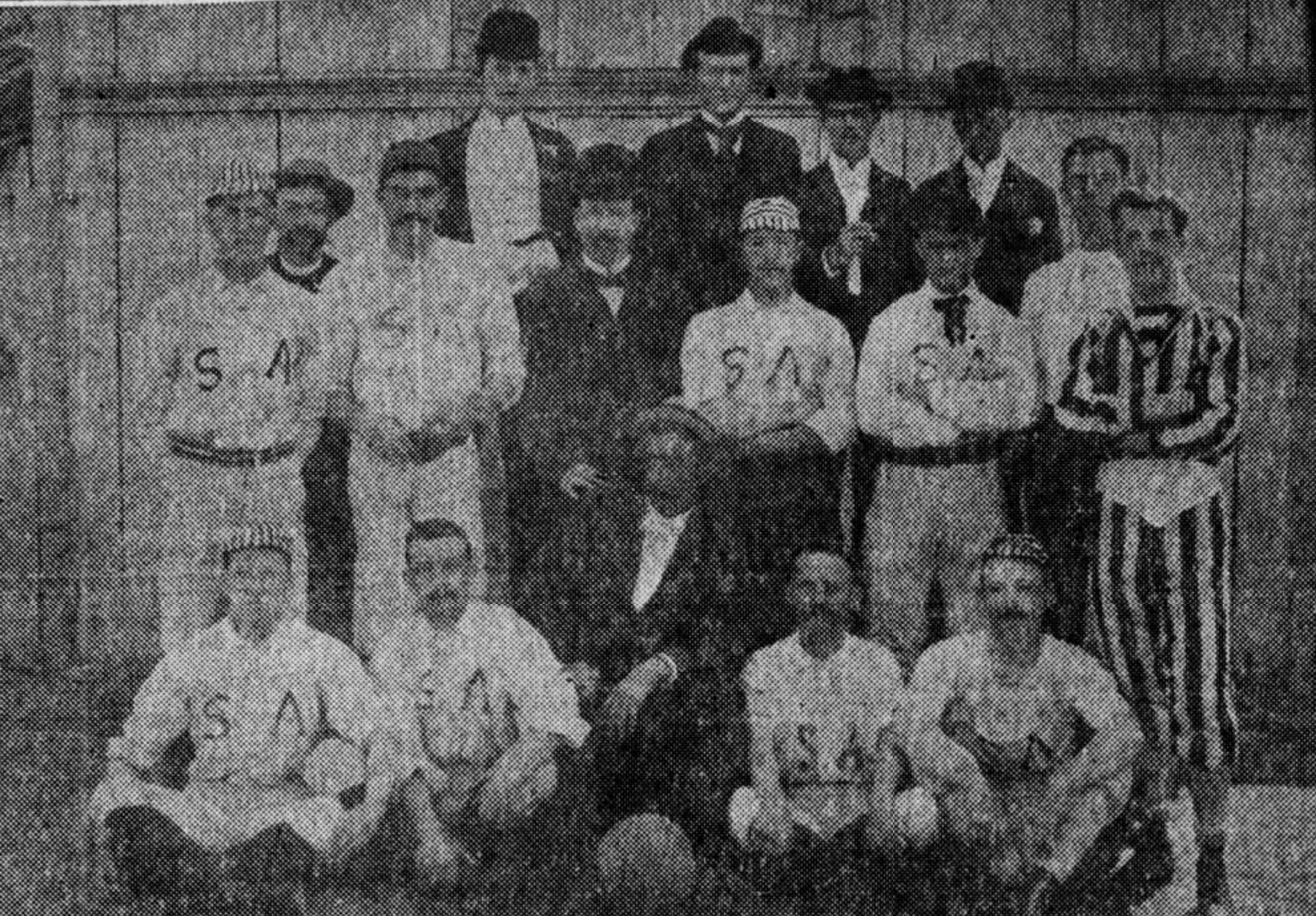
Around three hundred miles southwest, the same thing was happening at almost the same time. On November 22, 1891, the Mission Athletic Center and the San Antonio Amateurs met at San Pedro Springs Park, the oldest public park in Texas. A photographer lined up both teams that day, and the pictures survive as the oldest known images of football, either code, in central Texas.
A San Antonio reporter looking back in 1935 could barely believe the soccer guys had gotten there first, but the record was the record. As that retrospective explained, the clubs picked up the game partly because “baseball was a summer game” and they wanted something to do once it cooled off. Soccer was the first organized football of any kind in San Antonio. It just did not stay that way.
The sport that almost vanished
The college game, the carrying-and-tackling version that became American football, was blowing up across campuses in exactly these years. The University of Texas played its first varsity football game in 1893, and the new sport vacuumed up the players, crowds, and newspaper ink that might otherwise have gone to the quieter kicking game. By the time anyone tried to bring soccer back in Dallas, it had been gone long enough to feel like a rumor. When organizers floated a new team in 1908, The Dallas Morning News pointed out it was not actually new:
“The game was in vogue twelve or thirteen years ago but gave way to the college style of playing, known as Rugby.”
The Dallas Morning News, November 12, 1908
Twelve or thirteen years before 1908 puts you right around 1895 and 1896, just after those first 1891 matches. The kicking game had flickered, caught for a moment, and then gotten smothered. Bringing it back would take a stubborn Englishman.
Ernest Oates and the Dallas Athletics
Ernest Oates was a 32-year-old stonemason from Yorkshire who had been in Dallas only a couple of years in 1908. He missed the football of his boyhood, and like a lot of transplanted Englishmen, he knew just about everyone in town who had come over from England, Scotland, Ireland, and Wales. He rounded them up into a team, the Dallas Athletics, and started practicing at the Lake Cliff ballpark.

Oates had one problem. He had built the only real team in town, which meant he had nobody to play. Then help showed up from the strangest direction. The Dallas Morning News put together a team of its own, mostly guys who, a few weeks earlier, had been the newspaper’s baseball team. Not one of them had ever played soccer. But, as the paper put it, “they were game.” The Athletics usually won.
After just four games, the two teams declared a championship. They billed their Christmas Day, 1908 meeting as a showdown between, in their own words, “the only two thoroughly organized soccer football teams in the state of Texas.” Bold claim, and probably even true, which tells you how thin the ground still was. The Athletics took it three to nil.
Fort Worth throws the first elbow
Want proof the Dallas and Fort Worth rivalry predates almost everything? Cowtown could not field an official side until late 1909. In the meantime, The Fort Worth Star-Telegram entertained itself by lobbing sarcasm at its neighbor’s weird new pastime, at one point even dragging the recent and deadly Trinity River flood into a joke at Dallas’s expense. When Fort Worth finally did take the field against the Athletics, it got hammered.

The boosters were positive the sport was about to take over. In December 1909, a writer in the Austin Statesman ran a headline that has echoed through Texas sports pages for more than a century: “Soccer is bound to win.” His pitch was that soccer was the people’s game, open to anyone, no matter their size or their bank account:
“We want a safe and sane sport that every one of us can play and enjoy. We do not want an elaborate coaching system. We just want to feel fit and play a hard, fast game without fear of serious injury, and do this regardless of the weight of the men with whom we play. In a game like soccer a big man has nothing on his smaller opponent. Speed and courage are more in demand than strength.”
Austin Statesman, December 19, 1909
It was the first of countless Texas articles promising soccer’s inevitable triumph over football and baseball. That prediction would get made, and would flop, over and over for the next hundred years.
Who actually kept the game alive
Soccer did not hang on in Texas because of fancy athletic associations. It hung on because working people kept playing it.
In the coal-mining town of Thurber, west of Fort Worth, the company imported miners from Italy, Poland, Britain, Ireland, Mexico, and a dozen other places, and they brought the games of home with them. Along the rail lines linking San Antonio to Monterrey and Chihuahua, Mexican railroad crews put together teams like the Internationals and the Spaniards and challenged clubs in El Paso, San Antonio, Houston, and Dallas. By 1912 an organized game was running in all four cities.
What started in 1891 as a British and German pastime became, by the 1920s and 1930s, a Mexican-American institution. Spanish-language papers like La Prensa covered the matches with the kind of detail other papers reserved for college football, and local businesses sponsored an eight-team league. Kids turned the streets into pitches, enough that in 1924 La Prensa ran a comic poem griping that “con eso del futbol no se va poder vivir”, basically, with all this soccer, there’s no living with it. Women played too, in the city leagues and at schools like Incarnate Word, before that history got quietly erased during the war years.
Soccer is here to stay
Texas is still making soccer history. In 2026, both Houston and Dallas hosted matches in the World Cup, the biggest sporting event on earth, played in the world’s version of football. The Dallas-area games unfolded just a few miles from Oak Cliff, where the sport was first played on Texas soil 135 years earlier.
The boosters of 1909 were wrong about the timeline. Soccer did not win fast. But in Texas, it never really left either. Two footballs, two religions, and as it turns out, plenty of room in the state for both.
- Paula Bosse, “The Dallas Athletics, Dallas’ First Soccer Team — 1908,” Flashback: Dallas — primary newspaper coverage from The Dallas Morning News and The Fort Worth Star-Telegram, plus the comment thread documenting the 1890–1891 Dallas matches.
- “Soccer in San Antonio, 1891–1970,” Center for the Study of the Southwest, Texas State University — annotated archive of San Antonio soccer history with linked primary sources, including the 1891 San Pedro Springs match and the 1909 “Soccer is bound to win” article.
- “What’s the Origin of the American Word ‘Soccer’? Blame England,” Time — summary of economist Stefan Szymanski’s research on the Oxford “-er” slang origin of the word and its rise and fall in British usage.
- “Why Do Some People Call It Soccer?” History.com — background on the shortening of “association” into “soccer” and the 1905 New York Times letter.
- Melvin I. Smith, Evolvements of Early American Foot Ball: Through the 1890/91 Season — game-by-game record of early football codes, including the 1891 Dallas soccer matches.
- John Lenard, “Illustrated History of Dallas Soccer: Part 1,” 3rd Degree — history of professional soccer in Dallas from the 1967 Tornado onward.
- “[View of San Pedro Springs and Park],” Ernst Wilhelm Raba Photograph Collection, The Portal to Texas History (UNT Libraries) — historic photograph of the San Antonio park where the city’s first soccer match was played.
- “San Pedro Springs Park,” Handbook of Texas, Texas State Historical Association — background on the oldest public park in Texas.
- “Thurber, TX,” Handbook of Texas, Texas State Historical Association — history of the diverse coal-mining town and its immigrant workforce.